We have the same conversation with a CEO or a COO almost every week. The wording barely changes: "We already tried AI. Nothing happened."
Scratch the surface and the story repeats too. There was a support chatbot pilot. Someone wired up an automatic report summarizer. Marketing started drafting with AI. It all worked in the demo, everyone clapped, and six months later not a single number in the business had moved.
The usual diagnosis is that the model wasn't good enough, or that the team didn't adopt it. It's almost never that. The problem is structural: they ran pilots, not a flywheel.
A pilot is an event. You switch it on, you demo it, you switch it off. A flywheel is an engine: every turn leaves something behind that makes the next turn easier. The difference isn't technological, it's a design decision. And it's why two companies with access to exactly the same model end up in completely different places.
1. Find your core AI flywheel
Every company has its own way of growing, and you need to find yours. But across virtually every AI project we've built — agentic support, predictive logistics security, edTech platforms, assisted design — the core turns out to be the same four-step loop:
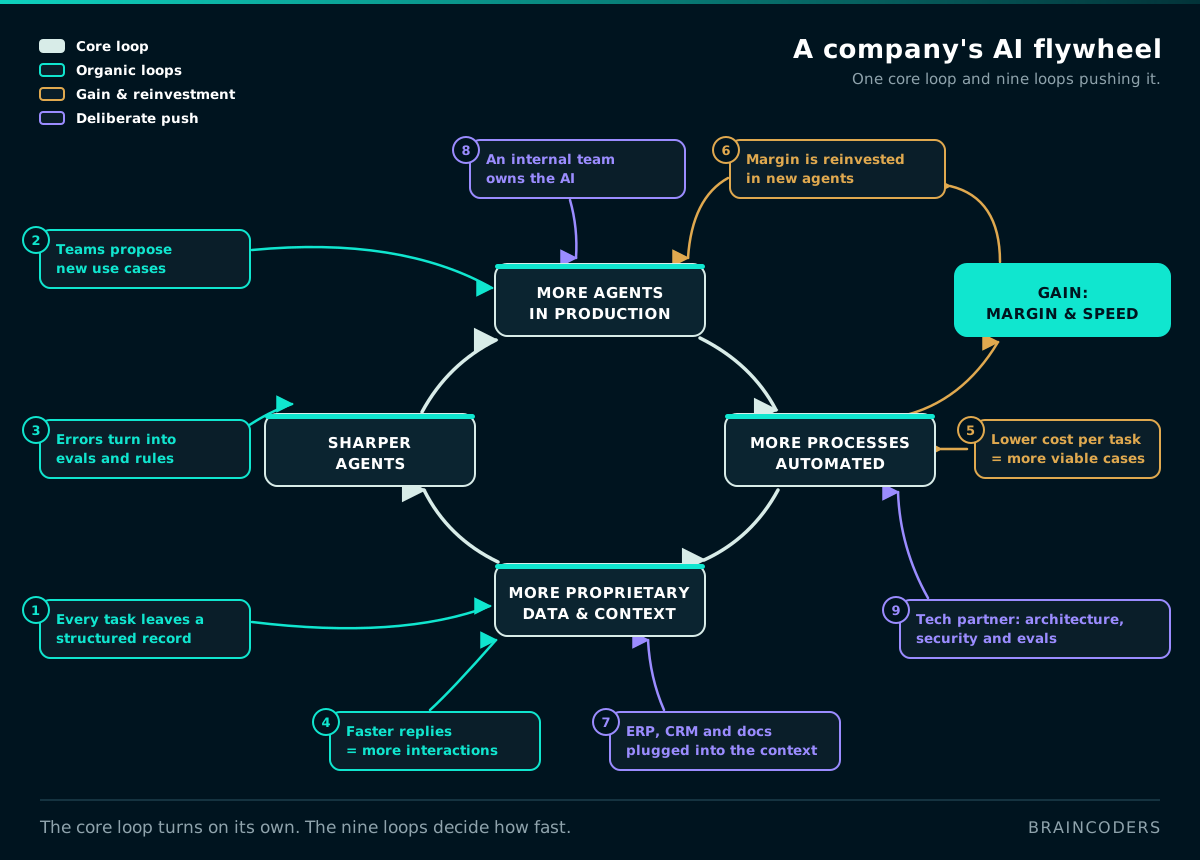
More agents in production → more processes automated → more proprietary data and context → sharper agents → more agents in production.
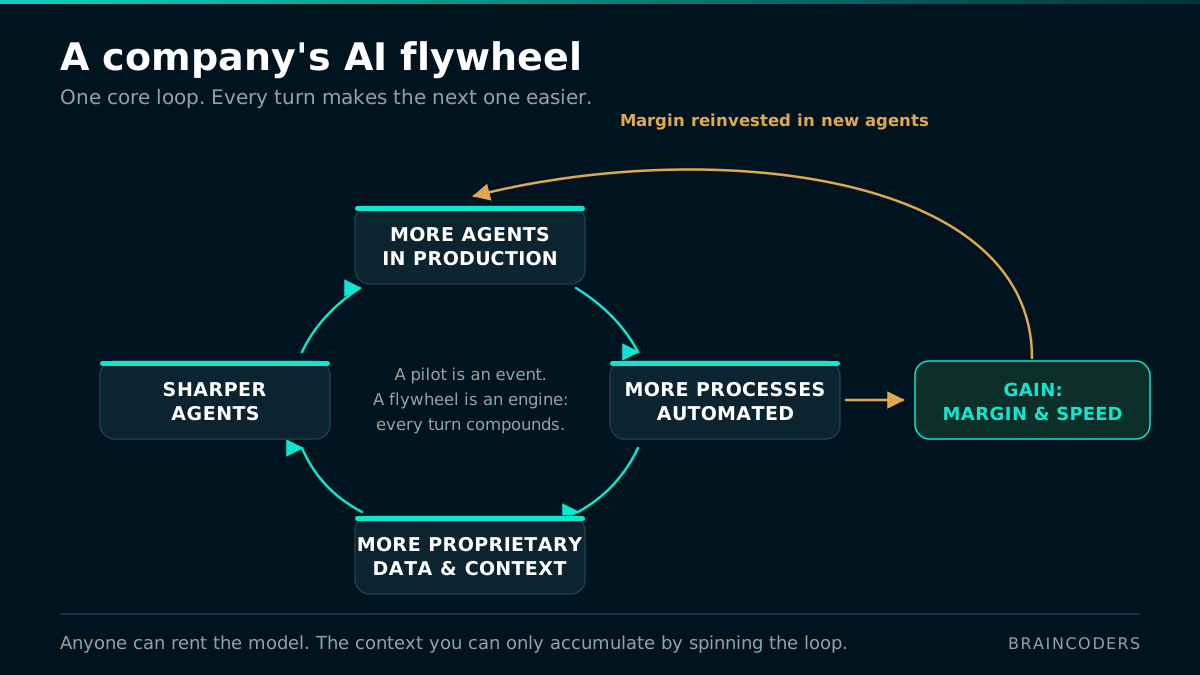
That's the core loop in the diagram above. Everything else spins around it. Each step is worth pausing on, because each one has a trap of its own.
More agents in production
The key word is production, not pilot. An agent in production is one a real process depends on every day: if it goes down, someone notices within the hour. A pilot lives in a sandbox, and if you switch it off nobody complains. Most companies that "already tried AI" have zero agents in production and believe they have five.
More processes automated
This is where partial automation breaks the illusion. If an agent handles 80% of a process but a human still has to review 100% of the output, you didn't automate anything — you added a step. A process counts when the human moves from operator to exception-handler, reviewing only what the system flags as uncertain.
More proprietary data and context
This is the step almost nobody designs for, and the only one that builds real competitive advantage. Every automated process leaves a trail: what was asked, what was answered, what was corrected, what was approved, how long it took. That trail is your proprietary context — your rules, your exceptions, your way of doing things. Anyone can rent the model; the context you can only accumulate by spinning the loop.
Sharper agents
With proprietary context, the next agent doesn't start from zero: it starts knowing how your company answers. And that's where the loop closes, because a sharper agent is one you can actually put into production without fear. Full turn.
2. The work is pushing and spinning that flywheel
Finding the loop doesn't make it spin. The real work — what growth people literally call pushing the flywheel — happens in two ways:
- Expand the output of each step. Add loops that amplify one specific step: every task leaves a structured record, errors turn into evals, teams propose new cases.
- Improve the conversion from one step to the next. How many pilots actually reach production? How many automated processes actually free up hours? That's where most of the value leaks out.
Nine loops push the core one. They fall into three families, and the distinction matters far more than it looks.
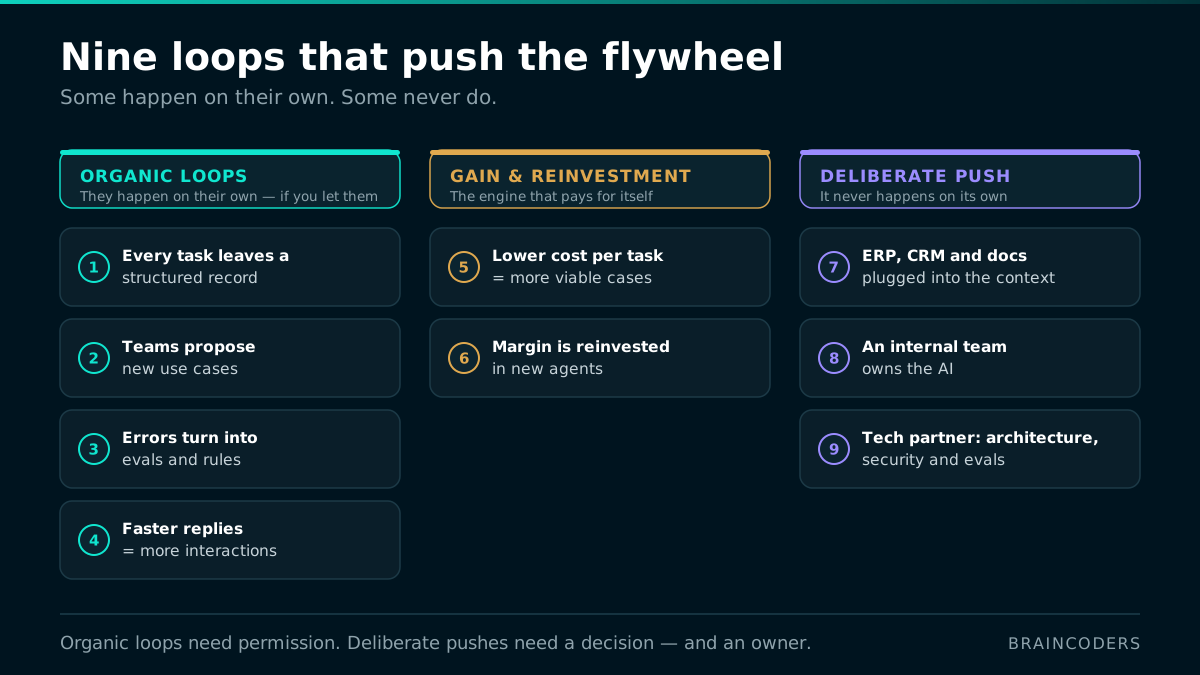
Organic loops: they happen on their own, if you let them
1. Every task leaves a structured record. Saving logs isn't enough. If every agent interaction is captured with its input, its output and the human correction, you get free training material every single day. Stored as loose text, you get a dead archive.
2. Teams propose new use cases. The most underrated loop of them all. Once a team sees an agent working in the next department's process, they start bringing ideas nobody asked for. Adoption stops being a top-down project and becomes internal demand. The catch: it only fires if the first case was visible and genuinely useful.
3. Errors turn into evals and rules. Every time the agent gets something wrong and a human corrects it, that case should become an automated test. That way the error can't come back in the next version. Without evals, every improvement is a blind bet: you fix one thing and break another without noticing.
4. Faster replies mean more interactions. When response cycles drop from days to minutes, customers and internal teams use the system more. More usage means more data, and more data feeds step three of the core loop.
Gain and reinvestment: the engine that pays for itself
5. Lower cost per task means more viable cases. The most counterintuitive effect. When the cost of running a task falls, processes that were never worth automating — because the savings didn't cover the build — suddenly are. The universe of viable cases expands on its own.
6. Margin is reinvested in new agents. Margin and freed-up hours are the flywheel's actual gain. Reinvest that gain into the next agent and the loop self-funds. Absorb it silently into operations and the flywheel turns once, then stops.
Deliberate push: it never happens on its own
7. ERP, CRM and documents plugged into the context. An agent without access to your systems is a brilliant intern without keys to the office. Integration is unglamorous engineering work, and it's exactly where it's decided whether the agent is useful or not.
8. An internal team owns the AI. Someone inside the company has to own the flywheel: deciding what gets automated, reviewing evals, setting priorities. It doesn't need to be a big team, but if AI belongs to "everyone", in practice it belongs to no one and stalls at the first hard quarter.
9. A tech partner for architecture, security and evals. The three pillars that never show up in the demo and always show up in production. Architecture so the system survives the tenth agent and not just the first, security so company context doesn't leak, and evals so you know whether a new version is better or worse than the last one.
Put the core loop and the nine together and you get the whole engine in one picture — which step each loop pushes, and which colour it belongs to:
3. How to tell whether your flywheel is spinning
A flywheel you don't measure is one you can't push. These are the minimum metrics per step, and the typical symptom when that step is stuck:
| Loop step | What to measure | Symptom that it's stuck |
|---|---|---|
| Agents in production | How many agents serve a real process without a full human safety net | Lots of demos, no process that breaks if you switch the system off |
| Processes automated | % of cases closed without human intervention | The agent answers, but a human reviews 100% of the output |
| Proprietary data and context | Interactions captured in a structured, reusable way | Everything ends up in text logs nobody opens again |
| Sharper agents | Pass rate on the eval set, version over version | No evals; quality is argued through anecdotes |
| Gain | Hours freed and cost per task | Nobody knows what the process used to cost |
If you can't fill in the second column, that's your first project — before buying anything.
4. Quick diagnosis: where is your company stuck?
- "We have lots of tests and nothing in production." Stuck between step 1 and step 2. Almost always an integration problem (loop 7) or an ownership problem (loop 8) — not a model problem.
- "The agent works but we still review everything." Stuck at step 2. You're missing the eval set that would give you confidence to drop full review (loop 3).
- "Every new agent starts from scratch." Stuck at step 3. You're not capturing context: the flywheel spins but never compounds.
- "It worked the first year and then plateaued." The use case saturated, and there's no reinvestment (loop 6) or pipeline of new cases (loop 2).
5. Every initiative saturates. The engine doesn't.
This is the part most often forgotten. Every AI initiative follows its own curve: a traction phase, an optimization phase, and then saturation. That's normal and expected.
But when an agent saturates, your company's AI isn't over — that use case is. If the engine is already built (structured data, evals, security governance, an owning team) the next case costs half as much and ships twice as fast, because loops 1, 3, 7 and 8 already exist and aren't paid for twice.
That's the entire difference between a company that did AI once and one that grows with AI every year.
What we do at Braincoders
We're a software development studio. We design, build and deploy the engine: the agents, the integrations with your systems, the architecture so it holds up at the tenth case and not just the first, and the evals so you know whether you're improving or just changing things.
We're equally clear about what we don't do. We don't provide legal or regulatory advice, we don't replace your domain specialists, and we don't put anything critical into production without security and testing in between. Our edge isn't writing code with AI — plenty of people do that now. It's the strategic honesty to structure a project before building it, and to flag risk when we see it.
Want to see what your AI flywheel would look like? Book a discovery call and we'll map your core loop, the step that's stuck and what it takes to get it spinning.